
Before You Scale AI, Build Your Company Brain
A practical guide to shared knowledge, departmental AI, and the foundations of agentic operations
Download the PDF
A WHITE PAPER FOR SMALL BUSINESS LEADERS How to give AI agents a consistent understanding of your business, reduce conflicting information across departments, and introduce greater autonomy with appropriate controls. |
|---|
Prepared by Integral Associates
November 2026 | Strategic guidance and implementation framework
READING GUIDE
Inside this white paper
Begin with the business case, then use the implementation and assessment sections to decide what to do next.
| 01 | The hidden problem with AI adoption |
|---|---|
| 02 | What a Company Brain is |
| 03 | One company, multiple division brains |
| 04 | What goes into the brain |
| 05 | When a brain becomes necessary |
| 06 | How it supports agents and dashboards |
| 07 | Ten practices that keep it trustworthy |
| 08 | Build your first brain in 30 days |
| 09 | Company Brain readiness assessment |
| 10 | From brain to agentic organization |
THE DECISION IN ONE SENTENCE
Build a small, accurate knowledge foundation early. Add connected data, scoped permissions, human approvals, and monitoring as AI systems gain responsibility.
Executive Summary
Small businesses are moving from individual AI assistants toward systems that answer customers, update records, prepare proposals, report performance, and coordinate work across departments. This is useful progress. It also exposes a problem that basic AI experiments often conceal: each tool may have a different understanding of the company. One assistant knows last quarter's pricing. Another has the current offer but an old delivery procedure. A third has access to the CRM but no reliable definition of what counts as a qualified opportunity. When those systems start working together, inconsistencies can become operating errors.
A Company Brain gives people and authorized AI systems a dependable starting point. At its simplest, it is a concise, structured set of approved briefings covering the business, its customers, offers, procedures, responsibilities, and rules. As AI adoption grows, this knowledge foundation can connect to division-specific reference material, current operational systems, controlled memory, and technical permissions. The goal is straightforward: every AI system should receive the context it needs to perform its assigned work, using sources the company trusts.
A full technical platform is not a prerequisite for writing an email with AI or testing an internal chatbot. But a governed knowledge foundation becomes strongly advisable when several departments deploy company-specific AI. Before agents perform consequential actions or coordinate across systems, reliable sources, access controls, approvals, and monitoring are essential. This paper explains that progression, introduces a practical company-and-division structure, and gives leaders a 30-day starting plan. The advice is deliberately proportionate: start with one business problem and a small set of accurate documents, prove the result, then expand.
THE CENTRAL RECOMMENDATION Give AI a consistent understanding of the business before giving it broader responsibility. Build the knowledge foundation early and strengthen governance as agents gain access, tools, and authority. |
|---|
1. The Hidden Problem With AI Adoption
Consider Northstar Services, a fictional company with 42 employees across sales, customer support, delivery, and finance. The CEO uses a general AI assistant to examine growth opportunities. Marketing has a separate tool for campaigns. Sales drafts proposals with a third assistant. Support uses an AI answering system, while operations experiments with automated onboarding. Each application improves an isolated task. Collectively, however, the company is beginning to develop several competing descriptions of itself.
Marketing works from a product description prepared six months ago. Sales has a newer pricing sheet, but the proposal assistant also references a discount that has expired. Support still uses the old cancellation policy. Operations has an onboarding checklist that does not include a service introduced in September. The CEO asks for an executive dashboard and discovers that sales reports contract value, finance reports recognized revenue, and operations reports completed work. None of these measures is inherently invalid. They answer different questions, and nobody has defined how the dashboard should distinguish them.
These problems are easy to overlook when a person checks each response before acting. They become harder to control when an agent responds to customers or updates systems without constant supervision. The company may move faster while also making mistakes faster. A customer hears an unauthorized promise, a proposal uses an incorrect price, or a manager makes a decision from a confident summary built on mismatched numbers.
Three kinds of fragmentation explain what is happening. Knowledge fragmentation occurs when departments maintain conflicting versions of important facts. Tool fragmentation occurs when assistants are configured separately and changes do not reach them consistently. Operational fragmentation occurs when an AI workflow cannot reliably pass information to the next responsible person, agent, or system. Together they produce repeated briefing, rework, uncertain accountability, and inconsistent customer experiences.
The answer is not to prohibit departmental experimentation. Small businesses benefit from employees finding better ways to work. Leadership must, however, establish shared rules for information that should be consistent across the organization. Employees may legitimately use different techniques and specialized procedures. The company still needs a common account of its approved offerings, obligations, priorities, and decision rights. That need becomes more urgent as AI moves from preparing drafts to performing business work.
2. What a Company Brain Is
A Company Brain is a structured, purpose-built system of approved organizational knowledge that gives authorized employees and AI agents a consistent understanding of the business. It explains who the company is, whom it serves, what it sells, how work gets done, and which rules govern that work. Its initial form can be remarkably simple: a short introductory briefing supported by carefully maintained documents. It becomes more capable as retrieval, current operational information, memory, and controlled actions are added.
Think about onboarding a new employee. A useful orientation explains the company's purpose, customers, services, standards, team structure, and the limits of the person's role. A new sales representative needs the current offer, qualification criteria, pricing and approval rules. An operations coordinator needs delivery procedures, handoff requirements and escalation contacts. Neither employee needs unrestricted access to every payroll file or every customer contract. AI systems require similarly specific context, though their access must be enforced through software as well as instructions.
The phrase Company Brain should not be confused with a giant folder of every file a company owns. Project drafts, raw transcripts, contracts, transaction histories, and archives may all be relevant, but they serve different purposes. The brain identifies which documents are authoritative and how each source should be used. In a well-run system, an employee can ask where to find a current policy and receive a reference to an approved version, rather than an answer blended from several old copies.
It is also useful to distinguish the brain from other systems. The CRM remains the authoritative source for sales records. Accounting software remains the authoritative source for financial transactions. A project system owns current task status. The brain contains approved definitions, policies, context and pointers, while appropriately configured connections retrieve the current records needed for a task. This avoids copying sensitive and fast-changing information into yet another database that must be reconciled.
The brain performs four practical jobs. It supplies common context so employees and agents speak accurately about the organization. It provides specialized knowledge for particular jobs. It identifies ownership and authority, so an AI system knows when to escalate. And it supports continuity, allowing approved corrections and decisions to improve subsequent work. None of these jobs requires a sophisticated platform on day one. They require deliberate structure, accurate sources, and someone responsible for keeping them current.
A USEFUL DISTINCTION The briefing documents tell an agent how the business works. Connected source systems tell it what is happening now. Software permissions determine what it is allowed to read or change. |
|---|
3. One Company, Multiple Division Brains
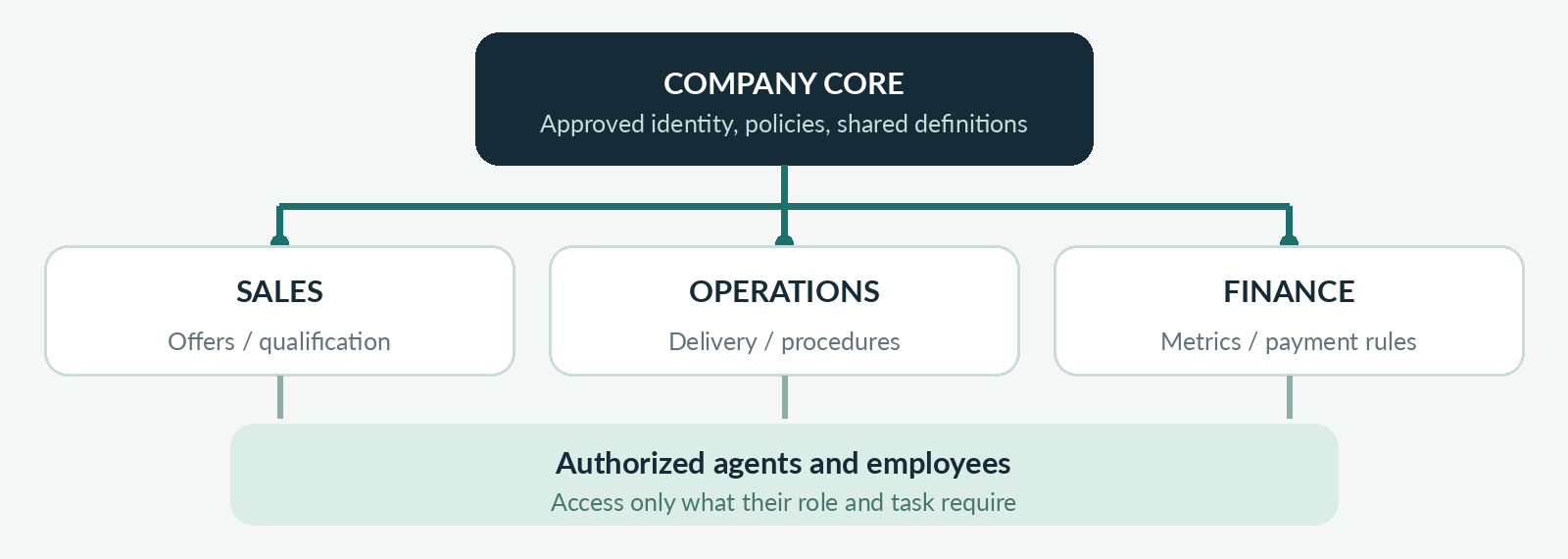
FIGURE 1 | Shared corporate context with scoped division knowledge and authorized access
A growing business needs a shared corporate identity without pretending every department operates in the same way. A useful design begins with a Company Core and adds division-specific brains. The corporate level establishes organization-wide identity, positioning, policies, terminology, approved company-wide offers, leadership priorities, and cross-division rules. Division brains explain the customers, work, processes, and decision rights particular to each business unit.
For example, Northstar's corporate briefing might define its brand promise, customer commitments, service standards, and leadership structure. Its Sales brain would describe prospect qualification, proposal templates, commercial approval rules, and the current offer catalog. The Delivery brain would define onboarding, quality checks, project milestones, and escalation procedures. Finance would maintain payment policies and authoritative metric definitions, while sensitive employee or financial records remain in restricted systems. All four teams share the company's core understanding but retrieve different operational detail.
This is a logical structure, not necessarily a physical database design. A small company might keep approved documents in a well-managed Drive or SharePoint structure. A larger SMB might index them in a secure retrieval service connected to several applications. The architecture should reflect how the company operates and who is allowed to access each information category. A folder name alone never establishes a permission boundary.
There is a second useful distinction between full division brains and lightweight property brains. A stable operating division may need its own customers, offers, delivery procedures, team ownership, and financial policies. A temporary campaign or cross-divisional website may need only a concise overview, audience definition, promoted offers, current campaign rules, and pointers to the relevant division sources. Creating an elaborate independent brain for every landing page introduces maintenance work without improving the customer experience.
Cross-division handoffs deserve explicit documentation. Suppose Sales closes an annual service agreement. Delivery needs the signed scope, target dates, customer contacts, special commitments, and acceptance criteria. Finance needs approved payment terms and the appropriate billing record. The Company Brain can define that handoff contract, while the CRM, document repository, and project system retain the actual records. A responsible manager should be able to answer three questions: what transfers, who owns the next step, and how will completion be verified?
This architecture makes organizational differences visible and manageable. It also reduces the risk that one division's pricing, confidentiality rules, or practices are mistakenly applied to another. Shared information should be shared deliberately. Specialized information should remain appropriately scoped.
4. What Goes Into the Brain
The fastest useful starting point is a document called "00 Start Here." It should be short enough for an employee or AI agent to read before a new assignment, typically one or two pages. State what the company or division does, whom it serves, the main products or services, important rules, the expected communication style, related divisions, escalation instructions, and the last review date. When an agent is uncertain about price, eligibility, contract language, or authority, this opening document should direct it to the controlling source or responsible person. It should never encourage guessing.
A repeatable full-brain template can use ten numbered sections, from 00 through 09. The template is a useful organizing convention, not a mandatory taxonomy. Smaller businesses can combine sections while preserving clear ownership. Larger divisions can split dense subjects into several concise documents. Every section should state what it covers and what it excludes.
| SECTION | WHAT BELONGS HERE |
|---|---|
| 00 Start Here | Short orientation, critical rules, sources, escalation, owner and review date |
| 01 Company | Identity, positioning, voice, approved credentials and corporate direction |
| 02 Customers | Ideal customer profiles, needs, exclusions and verified case evidence |
| 03 Offers | Current products, prices, scope, eligibility, dates and approval rules |
| 04 Marketing | Messaging standards, channels, active campaigns and approved claims |
| 05 Sales | Qualification, proposals, follow-up and contracting controls |
| 06 Delivery | Onboarding, fulfillment procedures, quality checks and handoffs |
| 07 Revenue | Commercial policy, metric definitions, targets and restricted exceptions |
| 08 Team | Roles, ownership, decision rights and escalation contacts |
| 09 Archive | Superseded information isolated from current operating retrieval |
The 00 briefing should be the entry point, not a replacement for detailed reference material. The Company section covers mission, history, positioning, brand voice, and approved credentials. Customers covers ideal profiles, common problems, desired outcomes, disqualifying situations, and verified evidence of customer results. Offers contains one current, factual record per product or service, including scope, price, effective date, limitations, and relevant approvals. Marketing supplies message standards, channels, campaigns, and verified proof. Sales describes qualification, discovery, proposals, follow-up, and commercial guardrails. Delivery explains how commitments become completed work. Revenue specifies commercial rules and metric definitions. Team clarifies responsibilities and decision rights. Archive segregates superseded material from current retrieval.
The writing standard matters as much as the folder names. Agent-facing reference material should read like a briefing, not advertising. Write "Price: $2,400, effective November 1; manager approval required for discounts" rather than "competitive pricing with flexible options." Use clear headings, one primary topic per document, short sections, and explicit exceptions. Record the source owner, last updated date, effective period, review date, and access classification. Put important rules in plain language and explain the reason when that helps an agent make an appropriate escalation decision.
A reliable brain also needs source precedence. A current approved offer sheet generally outranks an archived campaign. A signed customer contract may establish a valid exception to the standard terms, but the exception applies only to that customer and engagement. A manager's informal meeting note should not silently replace an approved corporate policy. Where records conflict, the agent should identify the conflict, cite both sources where authorized, and ask the responsible person to resolve it.
Keep active project work in its operational home. The brain can describe how project management works and link to project records, but filling it with every draft, message, and client asset makes current policy harder to find. Similarly, retired documents need a controlled archive. Retention requirements may require deletion in some circumstances; "archive everything forever" is not a safe universal rule. The operational requirement is to preserve appropriate history without letting retired documents govern current work.
5. When Does a Company Brain Become Necessary?
The correct answer depends on what AI is being asked to do. A founder who uses an assistant to brainstorm a newsletter topic needs little organizational infrastructure. A sales assistant that drafts customer-specific proposals needs approved offers and pricing. An AI employee that changes records, sends external messages, and initiates operational tasks requires controlled data access, action permissions, and supervision. A company can begin experimenting before completing a formal brain, but it should not delay essential controls until after interconnected agents are operating widely.
At Stage One, individual productivity, approved company facts and a basic AI-use policy are helpful. Employees can use AI to draft, summarize, research, and develop ideas while remaining responsible for checking outputs. They should understand what information they are allowed to share with external tools. A full division structure can wait. The immediate management task is identifying where AI is already being used and which inputs require protection.
At Stage Two, departmental AI, a shared knowledge foundation becomes strongly recommended. Marketing, Sales, Support, and Operations may all answer questions about the same customers, offers, and policies. At this point, a concise Company Core and division-specific briefings reduce repeated setup and contradictory outputs. Management should appoint owners and establish an update process before expanding the number of customer-facing assistants.
At Stage Three, connected AI and dashboards, governed sources and technical access become foundational. Assistants may retrieve CRM data, read contracts, create project summaries, or combine financial and delivery metrics. The company must distinguish stable guidance from live records and establish agreed definitions. Authentication and access rules should be enforced at the source or retrieval layer. Displaying a warning in an agent's prompt is insufficient protection for restricted information.
At Stage Four, coordinated agentic operations, the control requirements are essential. Agents may hand tasks to one another, invoke tools, modify records, communicate with customers, or perform workflows across divisions. Each role needs a named owner, scoped authority, a clear completion condition, logging, an escalation path, and a way to stop or correct failures. Approval gates should apply to consequential actions such as financial commitments, contract changes, sensitive disclosures, and other high-impact decisions. The precise controls depend on the business and the risks of the action.
| STAGE | TYPICAL USE | BRAIN REQUIREMENT | CONTROL GATE |
|---|---|---|---|
| 1 Individual tools | Writing, analysis, research | Basic rules and approved reference facts | Review outputs before use |
| 2 Departmental AI | Company-specific assistants | Shared core plus division knowledge | Owner and update process |
| 3 Connected systems | CRM, dashboards, workflows | Live authoritative sources and permissioned retrieval | Source-level access checks |
| 4 Agentic operations | Cross-division actions and handoffs | Task memory, controlled tools, approvals, audit logs | Test, supervise and recover |
There are seven practical signals that a Company Brain should move up the priority list. Teams repeatedly rebrief AI about the same facts. Assistants provide contradictory answers. Current pricing or procedures are hard to identify. Several agents need the same client or project context. Dashboards disagree because metric definitions differ. Agents are receiving permission to modify operational records. Or leadership cannot identify which systems have access to sensitive information. Any one of these deserves attention; several together indicate that unmanaged expansion is becoming costly.
A fully engineered company-wide system can still be excessive for a very small business using one narrow AI receptionist. That business may need only current services, hours, escalation rules, appointment policies, and a secure connection to the calendar. The principle is proportionality: organize the information and enforce the authority appropriate to the job. Expand the architecture when additional value or risk justifies it. This approach gets useful systems into production without creating an expensive prerequisite project.
6. How the Brain Supports Agents and Dashboards
The practical task of a Company Brain is to supply relevant, reliable context at the moment work happens. An assistant preparing a sales proposal should not be given an uncontrolled download of the company's entire document collection. It should receive the current offer rules, the approved proposal format, authorized customer information, and applicable exceptions. The orchestration service should know which sources supplied that context and whether those sources were current.
A common technical method is retrieval-augmented generation, or RAG. Put simply, the AI searches approved documents or connected data sources when it needs information. The retrieved material helps it answer the question or complete the task. This can reduce reliance on generic model knowledge and old conversational context, but retrieval is not proof of correctness. Search may miss a document, return a superseded version, or find a source that contradicts another. Testing and visible source references remain necessary.
Dashboards reveal a related issue. Imagine the CEO asks, "What happened to revenue this month?" The company must define whether it means bookings, contracted value, invoices, recognized revenue, or cash collected. The numbers should come from their authoritative systems, while the Company Brain maintains the agreed definitions, calculation rules, and responsibilities. An AI-generated executive narrative should clearly distinguish verified numbers, plausible explanations, and recommendations requiring management judgment.
Agents also need working memory. A project agent may need to remember the task objective, constraints, last completed step, pending approvals, and files produced so far. That is different from the organization's approved long-term knowledge. A conversation containing an unverified guess should never become an official policy simply because the agent repeated it several times. Durable updates should be proposed, checked against evidence, and approved by an authorized owner.
For multi-agent workflows, one orchestrator can coordinate task-specific specialists. A Sales specialist gathers the approved proposal inputs. A Delivery specialist checks feasibility and scope. A Finance specialist verifies payment terms. A quality-checking agent reviews the assembled artifact, while a human approves consequential commitments. This pattern is useful because the roles and handoffs are explicit. Adding more agents without defined inputs, outputs, and permissions generally makes a workflow harder to supervise.
The Company Brain helps each component start with consistent context. It cannot, by itself, enforce authentication, repair a broken API, guarantee accurate calculations, or decide how much autonomy an agent deserves. Those responsibilities belong to the software architecture and the managers accountable for the work. Founders should ask to see both: the knowledge an agent uses and the controls that govern its actions.
7. Ten Practices That Keep the Brain Trustworthy
A useful Company Brain is maintained through ordinary management discipline. The first practice is to begin with a specific business problem. If the immediate goal is improving proposal accuracy, prioritize the offer catalog, sales policy, client context and approval rules. A company-wide document migration can wait. The second practice is to identify authoritative sources for every important information category, including where that information lives and who owns it.
Third, separate general and restricted knowledge. Public company descriptions can be broadly reusable; employee records, confidential client files, margin information, and draft partnerships need narrower permissions. Fourth, assign a named human owner to each knowledge collection. If a price or procedure changes, someone must be accountable for publishing the approved update. Fifth, agree on business terminology. Terms such as lead, active customer, completed project, renewal, and revenue should be defined with enough precision that different departments measure the same thing consistently.
Sixth, use explicit version and effective-date controls. A recent update is not automatically authoritative, and an older signed agreement may still govern a particular engagement. Record approval status and exceptions, not just timestamps. Seventh, give each AI agent the minimum access required for its current job. A customer-service assistant does not need unrestricted payroll records, and a proposal assistant should not be able to change company-wide pricing.
Eighth, require human review for consequential actions. Ordinary draft preparation may be low risk, while external commitments, payment changes, protected information, and contract language deserve stronger gates. Ninth, treat agent-generated discoveries as proposed knowledge. Verify them before adding them to the shared core. Tenth, evaluate the system continuously using realistic business cases, not only impressive demonstrations. Test stale documents, missing information, conflicting records, unauthorized requests, and interrupted workflows.
A workable maintenance rhythm combines event-driven updates with scheduled review. Change a critical offer, policy, or service? Update the governing source immediately and confirm the connected applications can retrieve the revision. Each month, inspect the short "Start Here" briefs and high-change offer records. Each quarter, review the wider knowledge collection, access assignments, and archived materials. More frequent reviews may be required for fast-moving products or regulated activities.
A useful rule is "approve once, distribute consistently." However, organizations should not assume that saving a new file updates every downstream agent. Some assistants use cached content, manually uploaded knowledge, or separately maintained indexes. A responsible implementation tests propagation and alerts someone when synchronization fails. It also maintains a correction history, making it possible to understand when a rule changed and which operational outputs may have been affected.
These recommendations reflect a broader governance principle. NIST's voluntary AI Risk Management Framework organizes risk work around governing, mapping, measuring, and managing. Microsoft guidance similarly emphasizes authoritative grounding, identity, permissions, and runtime controls for agents. OWASP identifies risks from tool misuse, compromised context, and insecure agent communication. For SMBs, the practical translation is simple: know the source, know the owner, know the authority, and check the result.
8. Build a First Company Brain in 30 Days
A small business can establish a useful first version without buying a complex AI platform. The objective of the first month is one approved knowledge foundation and one demonstrated workflow. Full automation can follow later, once the team understands how it will maintain and govern the system.
During Week One, choose a visible operating problem and inventory the AI tools already in use. Identify the company facts each tool needs, the records that govern those facts, and any obvious conflicts. Write a one-to-two-page "00 Start Here" briefing. Include what the company does, who it serves, the main offers, important rules, who can approve exceptions, and what to do when uncertain. Assign a business owner. The deliverable is a usable orientation, not a technology specification.
During Week Two, create the initial library. Collect the current company profile, approved offers, core policies, customer definitions, relevant procedures and ownership list. Ten to twenty concise sources may be enough, depending on the organization. Give each a title, owner, effective date, review date, status, and access class. Separate drafts and archives from current material. Resolve the most consequential contradictions before connecting the collection to AI.
During Week Three, connect one bounded workflow. It might answer internal policy questions, help prepare a proposal, or assemble a weekly management briefing from approved sources. Start with read-only access where possible. Test a set of ordinary cases, incomplete questions, old versions, conflicting documents, and attempts to obtain information beyond the user's role. Require the assistant to show its sources or state that it cannot verify an answer.
During Week Four, measure performance and decide what happens next. Compare task time, correction effort, factual accuracy, user confidence, and the quality of the final accepted work against the previous method. Fix unreliable retrieval, clarify ambiguous definitions, and document the update procedure. Select the next division or agent only after the first workflow performs consistently. If the workflow involves contracts, regulated data, payment activity or other sensitive actions, extend testing and security review as needed; thirty days is a planning model, not a production guarantee.
The practical purchasing decision follows the same progression. A do-it-yourself team can manage a modest document collection and a few assistants. A guided implementation can help clarify procedures, structure knowledge, and prove an initial workflow. A more connected system may require engineering for authentication, integrations, source synchronization, audit logs, and recovery. Leaders should buy the capability their present operating problem requires, not the most impressive architecture a vendor can demonstrate.
9. The Company Brain Readiness Assessment
The following assessment is an educational diagnostic, not a validated industry benchmark or security certification. Score each question as 0 for not established, 1 for partially established, or 2 for established and verified. The total can help organize priorities, but a high score does not excuse a serious access-control or privacy failure. The quality of evidence matters more than self-reported confidence.
| # | READINESS QUESTION | SCORE |
|---|---|---|
| 1 | Approved description of company, offers and priorities? | 0 / 1 / 2 |
| 2 | Authoritative sources identified for key facts and records? | 0 / 1 / 2 |
| 3 | Core procedures current and maintained by named owners? | 0 / 1 / 2 |
| 4 | Shared metric definitions and terminology agreed across teams? | 0 / 1 / 2 |
| 5 | Agents retrieve approved current information without uncontrolled copying? | 0 / 1 / 2 |
| 6 | Sensitive customer, employee and company information restricted? | 0 / 1 / 2 |
| 7 | Inventory of active AI tools and responsible owners available? | 0 / 1 / 2 |
| 8 | Agent action permissions and approval requirements documented? | 0 / 1 / 2 |
| 9 | Process exists to correct knowledge and approve new memory? | 0 / 1 / 2 |
| 10 | AI outputs and tool actions tested against realistic failure cases? | 0 / 1 / 2 |
A score of 0 to 7 suggests that the foundational knowledge and ownership should be established before expanding agent access. A score of 8 to 14 indicates a developing foundation with specific areas to strengthen. A score of 15 to 20 suggests that important pieces may be in place, but they should be tested with actual workflows and unauthorized-access scenarios before scaling autonomy. Treat these ranges as Integral's suggested coaching rubric, not a predictive model.
For each zero or partial answer, name an owner and select one observable correction. For example, "We will approve the current price sheet, archive the old version, and verify that the sales assistant uses the new price on five sample proposals." That is a much stronger action than "We need better AI governance." The assessment becomes valuable when it changes what the team does next.
The most revealing question is often this: if five additional agents were introduced tomorrow, could the organization show them the correct sources, responsibilities, permission boundaries, and escalation paths? If the answer is uncertain, the next investment should improve those conditions before increasing agent authority.
10. From a Company Brain to an Agentic Organization
As the knowledge foundation matures, a company can support more capable AI without briefing every assistant from scratch. Sales, Operations, and Finance can use common customer classifications and approved policies. Managers can review dashboards built from agreed definitions. Authorized agents can retrieve relevant project context, perform bounded tasks, and pass work to other agents with a clear record of what happened.
A typical progression begins with internal question answering, then proposal or service preparation, followed by controlled system integrations. Only after the company has demonstrated reliability should it introduce broader task execution and multi-agent coordination. Each expansion should have a business owner, a measurable outcome, known failure cases, and a rollback or correction process. Automation of a poorly designed procedure simply increases its throughput, including its mistakes.
There is a broader management benefit. Writing a useful brain forces leadership to make decisions that may have remained informal: who owns pricing, which policy prevails, how divisions hand work to one another, and what counts as a completed job. The result can improve employee onboarding and management consistency even before any agent is connected. That value is easy to miss if the initiative is treated solely as an AI software installation.
Still, a Company Brain has limits. It cannot manufacture accurate records, replace operational judgment, guarantee compliance, or produce benefits merely by existing. AI can misread a correct document, generate an incorrect recommendation, or execute the wrong action if its tools are too permissive. Leaders remain responsible for deciding where AI belongs, how much authority it receives, and what evidence demonstrates that it is helping the business.
The sensible ambition is an organization where people and AI systems can locate the same approved knowledge, understand their respective responsibilities, and improve work without multiplying confusion. That is a practical foundation for agentic operations, regardless of which models or software vendors the company uses next year.
Conclusion: Start Small, Then Scale Deliberately
The decision facing SMB founders is not whether to build a massive centralized intelligence platform. It is whether their growing collection of AI systems has a dependable understanding of the company and a safe way to act on that knowledge. Start with a concise approved briefing, organize the most important sources, assign owners, and test one useful workflow. As assistants spread across departments and agents begin changing records or coordinating tasks, add division context, live integrations, enforced permissions, approvals, and monitoring.
Before you add more AI employees, onboard them to the business. Before they coordinate across divisions, clarify the handoffs. Before they receive greater autonomy, establish the controls. Then judge the investment by better work, fewer corrections, and measurable business results.
Appendix A. Sample 00 Start Here Briefing
A good opening briefing is short, factual, dated, and designed for the next employee or agent who needs to understand the business. The following template illustrates the core structure. Replace the prompts with approved company information, and link to detailed documents rather than squeezing every procedure into the introduction.
| ITEM | WHAT TO INCLUDE |
|---|---|
| Company and purpose | What the business does, its customers, and the result it provides |
| Who we serve | Target clients, exclusions and customer-specific constraints |
| Current offers | Short offer list; link to controlled terms and effective prices |
| Critical rules | What an agent must never claim, change or commit to |
| Voice and standards | How to communicate, supported by approved examples |
| Responsibilities | Key owners, division handoffs and escalation contacts |
| When uncertain | Where to verify, when to ask, and when to stop |
| Document control | Owner, approval status, last review and next review |
Appendix B. Source and Implementation Notes
The Company Brain document structure and maintenance approach in this paper are adapted from Integral Corporation's internal "Integral Business Brain: Best Practices" (version 1.0, November 2026). The illustrative Northstar Services example, four-stage maturity framework, assessment scores, and 30-day plan are instructional models, not independent research findings. Technical architecture and security requirements should be adapted to each company's systems, contracts, applicable laws, and risk profile.
01. Internal methodological reference
Integral Corporation, Integral Business Brain: Best Practices, v1.0, November 2026. Adapted selectively for this public paper.
02. NIST AI Risk Management Framework
Voluntary framework for governing, mapping, measuring, and managing AI risk. Source
03. NIST AI RMF Playbook
Suggested operational actions within the AI RMF governance cycle. Source
04. Microsoft: Agent architecture and governance
Responsibilities for agent architecture, source-system access and governance. Source
05. Microsoft: Agentic behavior engineering
Practices for grounding, control, scope, evidence and runtime permissions. Source
06. OWASP: Top 10 for Agentic Applications 2026
Risks involving tool use, memory, agent authority and inter-agent behavior. Source
07. Google Cloud: Grounding with RAG
Reference guidance for retrieving source evidence in AI-generated answers. Source
INTEGRAL ASSOCIATES
Helping small business leaders turn AI adoption into dependable operating capability.